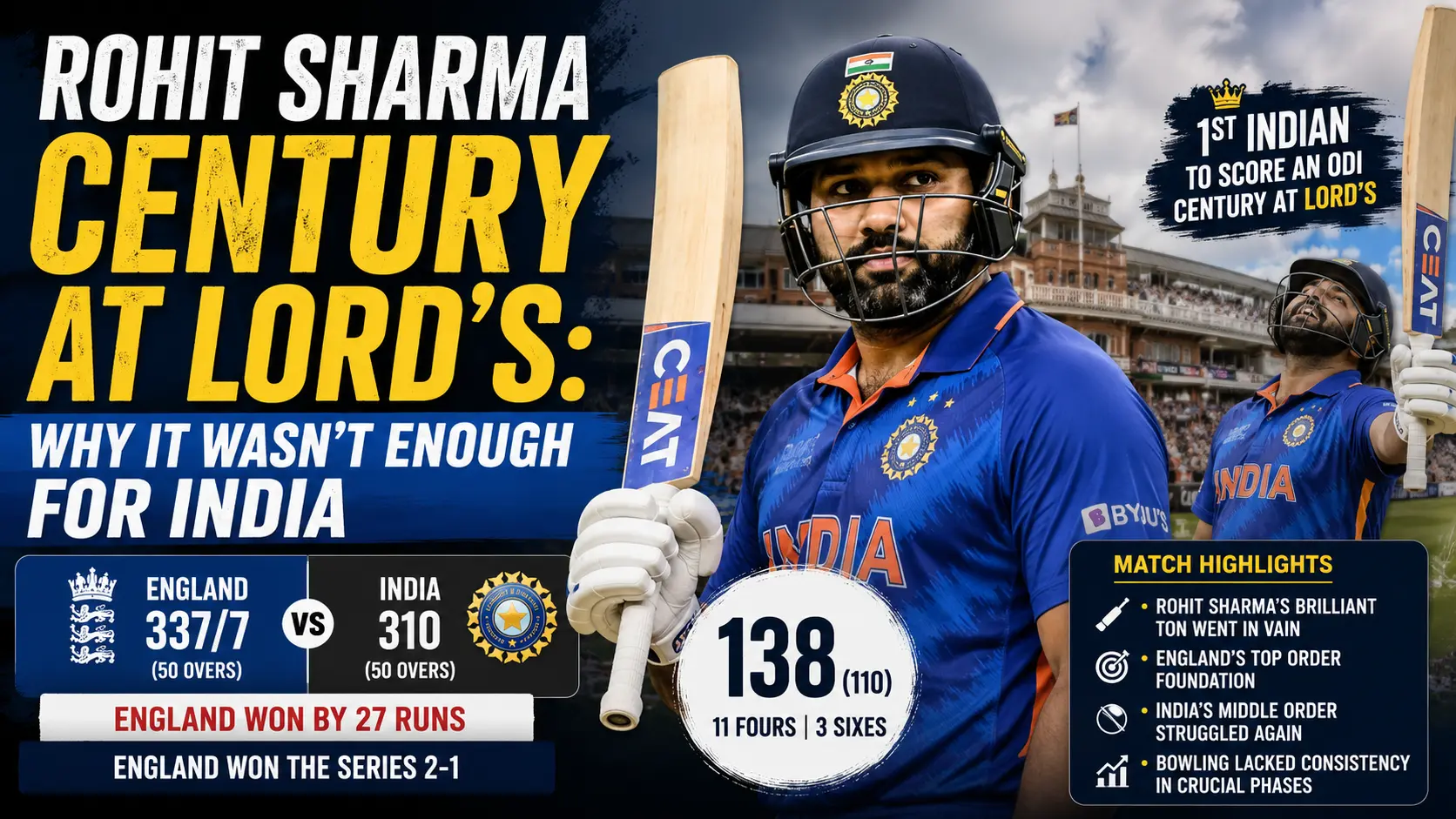
Rohit Sharma reminded the cricket world why he remains one of India’s greatest ODI batters with a stunning 138-run knock at Lord’s. The experienced opener played one of his finest innings under pressure, becoming the first Indian batter to score an ODI century at Lord’s. However, despite his heroic effort, India fell 27 runs short while chasing England’s massive target of 388, losing both the match and the ODI series 2-1.
The innings gave Indian fans plenty to celebrate, but it also highlighted a simple truth in cricket: one great individual performance cannot always overcome team shortcomings.
Match Summary
| Match | England vs India, 3rd ODI |
|---|---|
| Venue | Lord’s Cricket Ground, London |
| England Score | 387/3 |
| India Score | 360/7 |
| Result | England won by 27 runs |
| Series Result | England won 2-1 |
| Player of Discussion | Rohit Sharma – 138 (110 balls) |
Rohit Sharma’s Record-Breaking Century
Coming into the match, Rohit had faced criticism over his recent form. Instead of responding with words, he answered with his bat.
His innings included:
- 138 runs from just 110 balls
- 17 boundaries
- 5 sixes
- Strike rate above 125
- India’s first ODI century at Lord’s
- His 34th ODI hundred
The knock combined elegant drives, powerful pulls, and fearless attacking cricket. For most of India’s chase, Rohit kept the required run rate under control and gave India genuine hope.
Why Rohit’s Century Wasn’t Enough
Although Rohit batted brilliantly, several factors worked against India.
1. England Posted a Massive Total
The biggest reason was England’s first innings.
England scored 387/3, their highest ODI total at Lord’s, thanks to:
- Ben Duckett’s outstanding century
- Jacob Bethell’s valuable 91
- Joe Root’s unbeaten contribution
- Jos Buttler’s explosive finish
England added 82 runs in the final five overs, giving India an enormous target.
When chasing nearly 400 runs, even one outstanding century may not be enough.
2. India’s Bowling Missed the Mark
India struggled to control England’s batting throughout the innings.
The bowlers:
- Failed to build pressure consistently
- Allowed easy boundaries
- Couldn’t stop England’s late acceleration
- Leaked too many runs in the death overs
Those extra runs eventually became the difference between victory and defeat.
3. Rohit’s Wicket Changed the Match
While Rohit remained at the crease, India looked capable of completing a record chase. However, after he was dismissed in the 39th over, England regained control.
His wicket shifted the momentum completely. India still had talented batters left, but losing their set opener increased the pressure on everyone else.
4. England’s Bowlers Delivered Under Pressure
Defending 387 wasn’t easy. England’s bowlers kept attacking during the final overs.
Sam Curran’s crucial wickets, along with disciplined bowling from the rest of the attack, slowed India’s scoring when boundaries were most needed.
Instead of allowing India to finish strongly, England picked wickets at important moments.
5. Cricket Is a Team Game
A century can win matches—but only when the team performs together.
India also received useful contributions from:
- Shubman Gill
- Virat Kohli
However, chasing almost 400 required several batters to play match-winning innings. England produced better performances across both batting and bowling, making the difference in the end.
A Positive Sign for India
Despite the defeat, Rohit’s innings carried several positives.
It showed:
- He still performs in high-pressure matches.
- His timing and shot selection remain world class.
- Experience continues to matter in major ODI contests.
- He can anchor and accelerate during difficult run chases.
The innings also answered many questions about his recent form. After the match, Rohit brushed aside retirement speculation and said his focus remains on representing India and helping the team succeed.
What India Needs to Improve
To compete consistently against strong teams, India will need to focus on:
- Better death-over bowling
- Limiting runs during the final overs
- Taking wickets in the middle overs
- Building longer batting partnerships
- Converting strong starts into successful run chases
These improvements could help India finish close matches more consistently.
Fan Reactions
Cricket fans praised Rohit’s fighting spirit despite the defeat.
Many described it as one of his finest ODI innings because it came under intense pressure and nearly produced a historic chase. At the same time, many supporters felt India’s bowling performance had left too much work for the batting unit. Community discussions echoed the view that conceding too many runs late in England’s innings proved decisive
Key Takeaways
- Rohit Sharma scored a magnificent 138 at Lord’s.
- He became the first Indian batter to score an ODI hundred at the venue.
- England’s 387/3 proved too big despite India’s strong chase.
- India’s bowling and England’s late batting surge played a major role in the defeat.
- Rohit’s century restored confidence in his ODI form, even though India lost the series.
Frequently Asked Questions (FAQs)
Did Rohit Sharma score a century at Lord’s?
Yes. Rohit Sharma scored 138 runs off 110 balls, becoming the first Indian batter to register an ODI century at Lord’s.
Why did India lose despite Rohit’s century?
India lost because England posted 387/3, the bowlers couldn’t contain England in the final overs, and the chase lost momentum after Rohit’s dismissal.
What was the final result?
England defeated India by 27 runs and won the ODI series 2-1
How many runs did Rohit Sharma score?
Rohit Sharma scored 138 runs from 110 deliveries, including 17 fours and 5 sixes.
Why is Rohit’s innings considered special?
Apart from being the first ODI century by an Indian at Lord’s, it came under pressure during a huge run chase and silenced doubts about his form.






Leave a Reply